





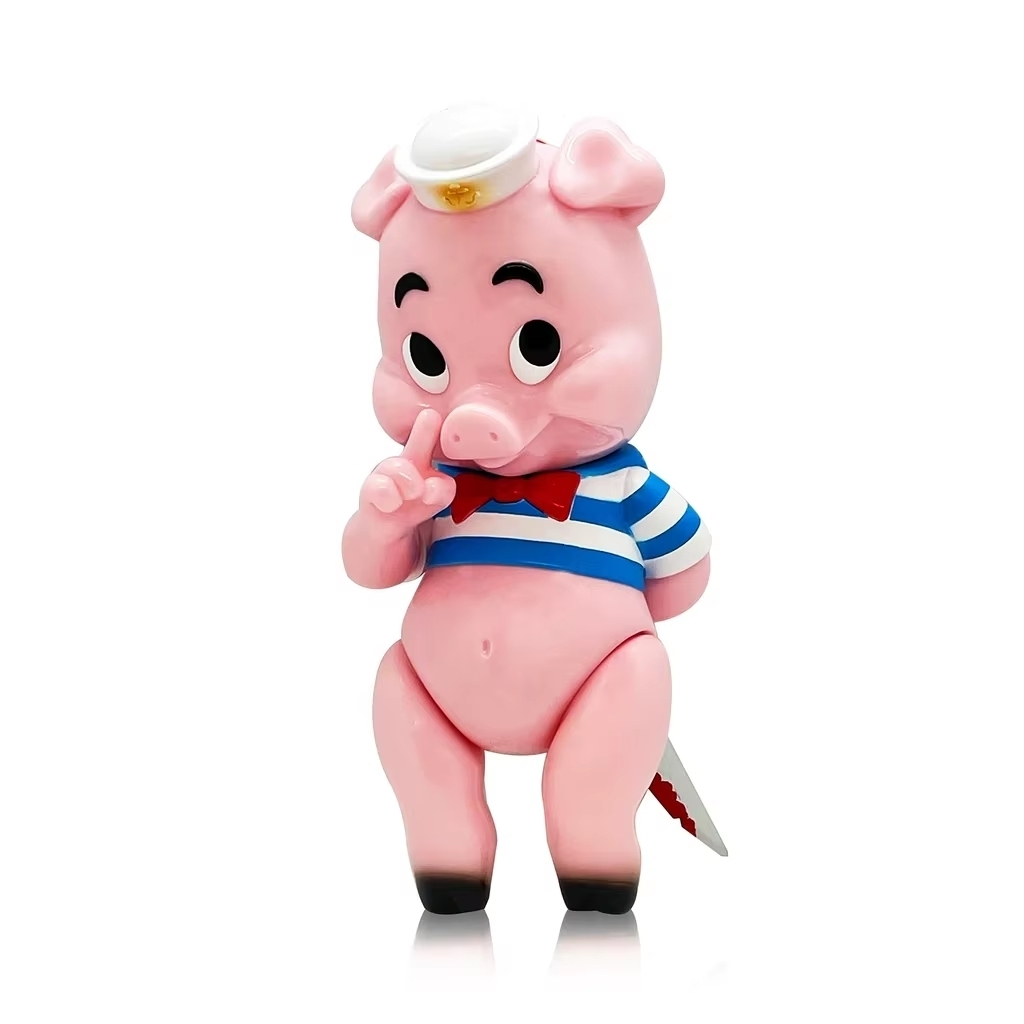
Movable Joint Figure
Product Description:
This Movable Joint Figure is a custom articulated character figurine with a playful sailor pig design. It is made of high quality vinyl and ABS materials, featuring solid structure, smooth surface and stable joint construction.
The figure wears a blue and white striped sailor shirt, red bow tie and white sailor hat. Its movable shoulder, elbow, hip and knee joints allow different action poses, making it suitable for dynamic display, photography and collectible play.
We support custom movable joint figure service, including character design, joint structure development, mold making, vinyl casting, hand painting and packaging. Suitable for action art toys, designer collectibles, brand gifts and limited edition releases.
- Movable Joint Figure, custom articulated character figurine
- Sailor pig design with blue and white striped outfit
- Vinyl and ABS material with stable movable joints
- Multiple action poses for dynamic display
- Custom design, joint structure, painting & packaging available
Note:
The toy figure images shown on our website are intended solely as references for customization and are not available for purchase. As a professional ODM/OEM toy manufacturer, we focus on customizing and producing toy figures of comparable style. If you have an original figure design you’d like to produce, please reach out to us for a quotation.
What a Movable Joint Figure Is?
Product Display
Joint Types
| Joint Type | Where It Belongs | What It Carries | How It Fails | What Removes the Failure |
|---|---|---|---|---|
| Single ball ★ | Head, hands, antennae | Light load, wide rotation. Buys two axes of motion for the price of one small tool | Loses friction fastest of all joints, because the whole contact is one small sphere | Vinyl socket sized against the ABS ball as a pair, plus a POM insert on any joint that will be posed often |
| Double ball | Shoulders, hips | The whole limb mass plus whatever the pose adds. The second sphere spreads wear across two contact zones | Loosens at the inner sphere first, so the limb starts dropping while the outer joint still feels tight | Two spheres on one pin with independent interference; test at the inner joint specifically, not the whole assembly |
| Hinge | Elbows, knees | One plane of motion at high load. Cleaner silhouette than a ball at the same point | Holds the plane but cannot correct for a sculpt that needed a second axis, so the pose looks stiff | Decide the motion axis at the joint layout stage; a hinge chosen to avoid a split line will read as stiff |
| Peg and socket | Wrists, ankles, removable parts | Rotation plus removability from the same geometry | Wears from being taken apart and put back, not from posing. Becomes a rattle, then releases under load | Keyed peg rather than round, so removal is deliberate; insertion depth specified so it cannot be over-pressed |
| Ratchet hinge | Heavy raised arms, held action poses | Holds a pose against gravity through detents rather than friction | Click positions may not match the pose the collector wants, and the teeth wear if forced past a detent | Tooth count and detent depth set from the poses the campaign actually needs, agreed before tooling |
| Swivel | Wrists, ankles, thigh rotation | Rotation around the limb axis only, which is often the missing degree of freedom | Adds a silhouette break where the limb meets the body, visible on a smooth character design | Place the swivel under a costume edge or a joint cover so the break reads as design |
Material Comparison
| Material | Role | Why It Works Here | What It Cannot Do | Best Pairing |
|---|---|---|---|---|
| Rotocast vinyl ★ shell, 2–4 mm | Body and head shell | Seamless soft surface that takes hand paint and reads as a designer art object rather than a toy. Hollow, so an articulated body does not become heavy at 10 in | Will not hold a socket round under load. The shell must be backed by a skeleton at every joint | ABS ball inside a vinyl socket, with interpolation sized for vinyl rather than copied from an ABS-on-ABS figure |
| ABS ★ | Joint skeleton, shells | Dimensionally stable at small section sizes, bonds to itself by solvent, takes a repeatable tool, and holds a socket round while the vinyl around it flexes | Reads hard and glossy if used as a visible surface at this scale; does not wear as a bearing surface | As the skeleton inside vinyl, or as a split shell where a crisp panel line suits the design |
| POM | Joint inserts, pins | Low friction and high wear resistance: the actual bearing surface inside a joint that will be posed hundreds of times | Does not take paint and does not bond by solvent, so it must be mechanically captured | Insert at double ball, ratchet and swivel joints; captured by the skeleton rather than glued |
| Injection PVC | Split body shell | Holds a crisp seam by design and takes a deep undercut with slides, which makes a complex articulated torso possible | Every joint becomes a mold split, so the seam layout is decided by the tool rather than by the character | When the design already has costume panels or armor lines at the joints |
| Soft vinyl (very low hardness) | Shell on soft-touch builds | The softest hand feel in the category, which some art toy audiences read as premium | Almost no dimensional stability at a joint opening: the socket deforms under load and the pose drifts | Only with a rigid skeleton and a metal or POM socket insert carrying the load |
| TPR / TPE | Overmolded joint covers | Flexible and grippy, useful for a visible joint cover that hides a split line and still allows motion | Can bleed plasticizer into a vinyl shell in contact over time, marking the paint | Separated from painted vinyl by a physical gap; declared to us before tooling |
Process Comparison
| Route | How the Joints Are Made | Tooling | Seam Reality | Repairability | Honest Limit |
|---|---|---|---|---|---|
| Rotocast vinyl over ABS ★ | Shell cast hollow in two or more parts, seam placed on a costume line or a designed groove; skeleton and joint pins assembled through the openings, then capped | $3,000–8,000 aluminum shell, plus small joint tools | One parting line per shell part, movable to a design line at the sculpt stage | High: joints open by design, so a pin can be replaced | Shell must be backed at every joint; a hollow shoulder with no skeleton will deform under the arm |
| Split injection PVC | Body cut into shells at the joint lines, each shell a separate cavity; joints formed by the shells meeting | $15,000–50,000 steel across the shell set | Every joint is a split, and the split layout is fixed by the tool | Medium: solvent-bonded shells do not come apart cleanly | Hard surface reads as a toy at this scale; cannot do a soft designer skin |
| Hybrid: vinyl shell, injected joint cores | Soft shell for the visible surface, rigid injected cores at each articulation point where the load is | Shell tool + core tools; highest tool count | Seam reads as a costume break because a real rigid part sits under it | Medium-high | The most honest build for a designer look that must also hold poses, and also the most tools to pay for |
| Silicone cast articulated resin | Each part cast separately from a silicone mold, joints formed by drilled or printed pins, assembled by hand | Low per mold, 30–80 pulls each | No design-led seam: every joint is an assembly, so seam hiding is manual work | Highest: parts are replaceable individually | Edition ceiling is mold life; a 60 piece articulated resin figure is the realistic top |
| 3D printed prototype joints | Joints printed in place or as separate parts at 0.1 mm layers, tested for range and retention | None beyond print time | Layer texture, not production surface | Highest, and every iteration is a reprint | Print material wears far faster than POM or ABS, so it proves the geometry and not the durability |
Where Movable Joints Fail
Floppy joint
The joint still moves freely but no longer holds. It is not broken: the interference was sized for a fresh part, and the first two hundred cycles took it away.
Pose sag under load
The figure holds an outstretched pose for an hour, then the arm drops. Hold force was never compared to the mass it has to carry at that lever length.
Split line across the face
Two shells have to come apart somewhere. On a smooth cheek the seam is the first thing photographed, and at this scale it cannot be painted away.
Undercut that cannot be pulled
A ball needs the socket to close around it. In a rigid mold that means a split, a slide or an insert, and none of those can be added after the cavity is cut.
Paint bridging the joint
Coating sprayed across a joint opening welds the two parts together. The figure arrives stiff, and forcing it chips the finish at the seam.
Socket creep in a soft shell
A vinyl socket left under load in a warm room slowly deforms. The joint opens up, and the design that held perfectly in the studio stops holding in a shop window.