





Custom Stuffed Animals Plush Toys
Product Description
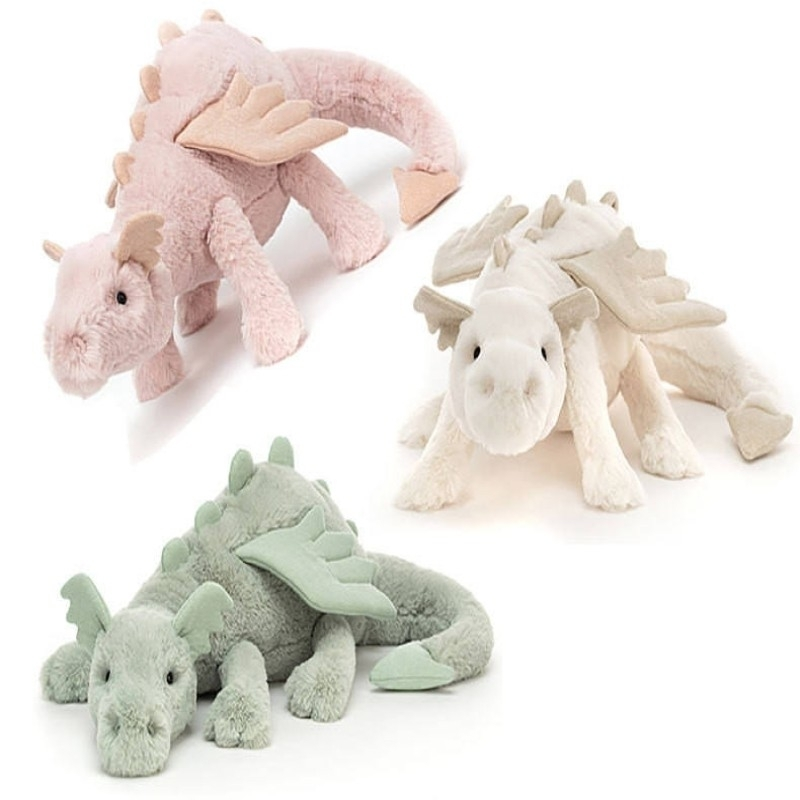
This Custom Stuffed Animals Plush Toy is a kawaii dragon plushie with soft fluffy texture. It is made of high quality plush material, featuring fine fibers, full stuffing, comfortable touch and durable structure.
The figure features a cute dragon design with gentle expression, small wings, curved tail and pastel color scheme. Its soft shape and rounded details make it suitable for children’s toys, collectible plush dolls, brand gifts and desktop decoration.
We support full Custom Stuffed Animals Plush Toys service, including character design, plush pattern making, sample development, sewing, stuffing and packaging. Suitable for brand mascots, promotional merchandise, children’s products and limited edition releases.
- Custom Stuffed Animals Plush Toys, kawaii dragon plushie
- Soft fluffy texture, high quality plush material and full stuffing
- Cute dragon design with gentle expression and pastel colors
- Comfortable touch, durable structure and safe for daily use
- Custom design, sample development, sewing & packaging available
Note:
The toy figure images shown on our website are intended solely as references for customization and are not available for purchase. As a professional ODM/OEM toy manufacturer, we focus on customizing and producing toy figures of comparable style. If you have an original figure design you’d like to produce, please reach out to us for a quotation.
What a Custom Stuffed Animal Actually Is?
Product Display
Material Comparison
Outer fabric
| Fabric | Hand feel and look | Where it limits you | Best for |
|---|---|---|---|
| Velboa (short pile) ⭐ first choice | Dense, smooth, low-loft pile; takes embroidery and print cleanly; holds shape well | Less "fluffy" than long pile; shows seam lines more clearly | Character plush where the shape matters more than the fluff |
| Minky | Very soft, silky, slightly stretchy; premium hand feel | Stretches under the needle — needs stabilizer and careful tension; pile direction is visible | Baby and premium gift plush |
| Boa / long pile | Long, loose fibers; the classic fluffy look | Sheds fibers during cutting and sewing; seam lines disappear, which hides defects but also hides quality | Kawaii and oversized cuddle plush |
| Cotton / canvas | Matte, structured, printable | Not soft; wrong for cuddling, right for decor plush | Printed graphic plush, decor items |
| Recycled PET pile | Very close to standard pile in feel; supports a substantiated recycled-content claim | Color consistency varies batch to batch; needs tighter incoming inspection | Brands with a sustainability commitment |
| Faux fur (long, sparse) | Realistic animal look | High shedding, difficult seam finishing, higher per-unit labor | Realistic animal replicas |
Filling
| Filling | Behavior | Use when |
|---|---|---|
| Standard polyester fiber fill ⭐ | Springy, light, recovers well after compression; the default for most plush | Almost always |
| Hollow siliconized fiber | Softer, more slippery, better loft retention over time | Premium hand feel, larger pieces |
| Cluster / bean fill (pellets) | Weighted base, sits upright, better balance | Bottom-weighted designs, sitting poses |
| Memory foam crumb | Heavy, slow recovery, very soft | Weighted comfort plush for adults |
| Under-filled | Cheapest, but collapses and looks flat on a shelf | Never — this is the most common cost-down that ruins a plush |
Construction Comparison
| Decision | Options and their consequences | Failure mode if done cheaply |
|---|---|---|
| Stitch type and density | Lock stitch at 8-10 stitches per inch is the durable default; overlock is faster but weaker on stress seams | Seam opens at the highest-stress point — usually where a limb meets the body |
| Seam allowance | 6-10 mm is normal; narrow allowance saves fabric and fails sooner under load | Fabric pulls out of the seam before the thread breaks |
| Eye anchoring | Washer-backed safety eyes set with a press, versus glued or stitched-on eyes | Glued eyes are a small-parts hazard and a recall trigger; they are never acceptable for under-3 |
| Closure method | Hand-sewn ladder stitch after stuffing, versus machine-close | Machine closure leaves a visible line and a weak seam on the most-handled area |
| Stress reinforcement | Extra stitching at limb joints, tail roots and wing attachments | The features that make a design cute are exactly the features that tear first |
| Embroidery vs print vs applique | Embroidery is durable and tactile; print is cheapest; applique costs labor but gives depth | Print on long pile disappears into the fibers and looks cheap |
| Accessory attachment | Sewn-in versus hook-and-loop versus loose | Loose or hook-and-loop accessories are removable small parts; a compliance problem, not a design choice |
| Label placement | Care and compliance labels sewn into a seam, positioned to stay readable | A label in the wrong seam is unreadable after stuffing — and unreadable labels fail audits |
Custom Design: From Sketch to Stuffed Sample
- Character brief and pattern intent. We review the drawing for proportion, which features will be grabbed or pulled, and where stress will concentrate — before pattern making, because that is where the fixes belong.
- Pattern making. The flat pattern is the real design file. We build it, then test it in a cheap fabric first so fit problems are found before the expensive pile is cut.
- Material and filling selection. Fabric chosen for hand feel and printability; filling chosen for loft, recovery and weight, with the fill ratio stated numerically.
- First sample (7 working days). Sewn, stuffed and finished, with eyes anchored and labels placed — a sample that can actually be tested, not just looked at.
- Revision round. Proportion, fill density and feature placement adjusted against your feedback, typically one to two rounds.
- Safety testing. Seam strength, torque and tension on eyes, small-parts cylinder check, and flammability where the market requires it.
- Golden sample and production. The signed sample becomes the reference; production follows the same pattern, stitch spec and fill weight.
Safety Standards & Certifications
| Standard / test | Scope | What it checks in a plush toy |
|---|---|---|
| CE marking | EU market access | Declaration of conformity for the finished plush |
| EN71-1 | EU mechanical safety | Seam strength, tension and torque on eyes and attached parts, small-parts cylinder, sharp points |
| EN71-2 | EU flammability | Surface burn rate of the pile fabric — relevant because plush is fiber |
| EN71-3 | EU migration | Heavy metals from dyes, prints and any plastic components |
| ASTM F963 | US toy safety | Seam and attachment testing plus labeling and age grading |
| CPSIA | US federal | Lead in dyes and hardware, phthalate limits in any plastic parts, tracking label requirement |
| Age grading (0-3 / 3+) | Both markets | Under-3 requires the strictest small-parts regime — no hard eyes, no removable accessories |
| Care label review | Retail | Washing instructions must match what the construction can actually survive |
| Prop 65 | California | Warning assessment on dyes and print inks |
| REACH SVHC / azo dye screen | EU chemical | Banned azo colorants and substance screening on dyed pile |
Care & Maintenance
- Surface wash first. Most plush does not need a full wash; a damp cloth with mild detergent handles the majority of marks and extends the toy's life.
- If washing, follow the sewn-in care label — it was written against the actual construction, not copied from a template.
- Wash on a gentle cycle inside a pillowcase or laundry bag. The bag reduces surface abrasion on the pile far more than a shorter cycle does.
- Never use hot water or a hot dryer. Heat sets fiber distortion permanently and can loosen the adhesive under printed panels.
- Air dry, and reshape by hand while still damp — the filling can be repositioned then, and not once it has dried in place.
- Do not wring or twist. Wringing shifts filling and produces a permanently lumpy toy.
- Brush the pile back to direction with a soft brush after drying; pile has a grain, and brushing with it restores the surface.
- For long-pile and boa fabrics, expect some fiber shedding in the first weeks. It reduces with handling and is not a defect.
- Check seams and eye anchors periodically on toys in heavy use. A small loose thread at a stress point is the warning before a seam opens.
- Store dry and uncompressed where possible. Long-term vacuum or heavy compression flattens filling, and some of that loss never recovers.
- Keep out of prolonged direct sunlight; dyed pile fades unevenly, and a faded plush cannot be retouched.