


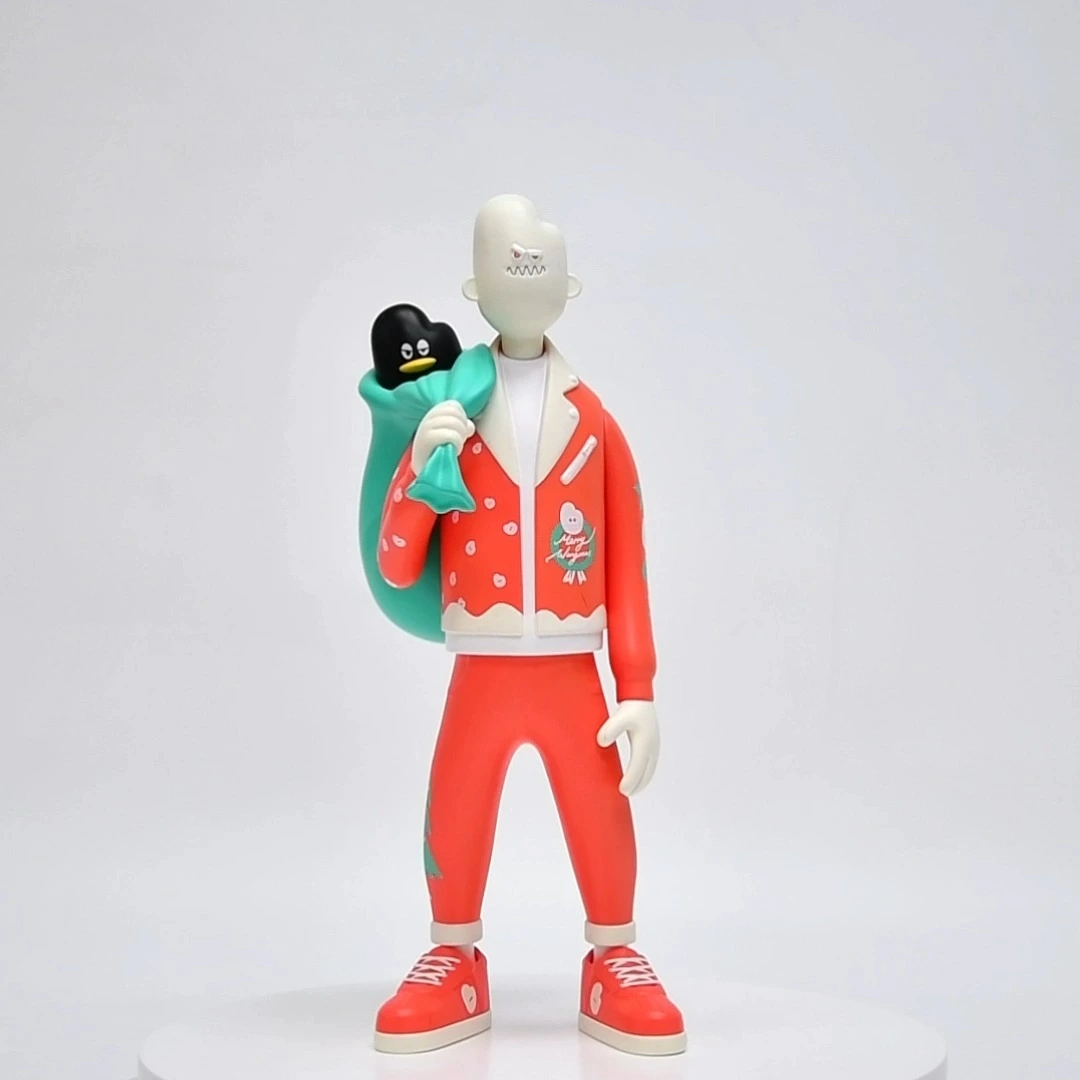


Transparent Vinyl Figure
Product Description
We create custom transparent vinyl designer art toys, this rotocast vinyl urban character figurine is made with see-through vinyl material, available for OEM and ODM orders with low MOQ. The sample features a gradient transparent yellow character with lip print suit, paired with a transparent red heart companion piece. The clear vinyl body lets light pass through, combined with gradient tint and internal printed graphics, bringing a unique translucent visual effect. Every piece is carefully hand painted, with clean color separation and smooth surface finish.
We support full service: character design, 3D sculpting, prototype, rotocast vinyl mold, transparent vinyl casting, gradient tinting, hand painting, assembly and packaging. Great for designer drops, limited edition collectibles, gallery display, brand collaboration art toys and urban toy series.
- Material: Rotocast Transparent Vinyl (Soft Vinyl / Sofubi Option Available)
- Special translucent & gradient tint effect, internal pattern printing
- Hand painted details, smooth polished surface
- Custom size, color, graphic design available
- Low MOQ OEM & ODM for designer art toy
- Full production workflow from sculpt to packed finished goods
Note:
The toy figure images shown on our website are intended solely as references for customization and are not available for purchase. As a professional ODM/OEM toy manufacturer, we focus on customizing and producing toy figures of comparable style. If you have an original figure design you’d like to produce, please reach out to us for a quotation.
What a Transparent Vinyl Figure Is?
A transparent vinyl figure is a hollow-wall collectible cast in see-through rotocast vinyl, typically carrying a gradient tint through the wall thickness, optional internal printed graphics, and hand-painted exterior details. Light passes through the body, so sculpted depth reads like glass and the tint shifts with the viewing angle and the backlight.
Buyers span three groups: designer-toy collectors who treat translucency as a premium finish, street-art and brand programs building a drop around a see-through statement piece, and gallery or display buyers who want a figure that interacts with its lighting. What all three are actually buying is discipline: the see-through promise only holds if the factory's surface and tint control hold.
Product Display
The Defect Visibility Ladder
| Trace | What it is | On an opaque figure | On a transparent figure |
|---|---|---|---|
| Weld lines | Faint seams where two flow fronts of molten compound meet | Hidden under base coat paint | Visible as a faint internal streak - controlled by tooling gate design and pour temperature |
| Flow lines | Orientation traces left by compound movement inside the mold | Covered by spray layers | Read as cloudy bands in backlight - managed by rotation speed in rotocast |
| Gate marks | Fill-point scars where compound enters the cavity | Placed under feet or hidden by paint | Placement must be planned on the sculpt stage, then polished after de-gating |
| Parting seams | The hairline where mold halves meet | Trimmed, rarely noticed | Every millimeter catches light - de-flashed plus polished seam work is a fixed process step |
| Air bubbles | Trapped air in the wall | Invisible once painted | Read as lens-like inclusions - controlled by compound de-airing and pour discipline |
| Tint variance | Unit-to-unit shade drift in the transparent dye | Moot - color is applied outside | Visible when units sit side by side - handled by tint-batch acceptance limits, not by hoping |
| Inner surface texture | Tool marks and roughness inside the hollow wall | Never seen | Read as frost or haze through the wall - inner finish becomes a specified surface |
Material Comparison
| Material | What it is | Why it suits transparent figures | Watch-outs |
|---|---|---|---|
| Transparent rotocast vinyl ⭐ | Clear soft-vinyl compound rotationally cast in aluminum molds into hollow walls | Built for see-through bodies: even wall layup, deep tint possible through wall thickness, premium squeezable feel | Wall thickness is the optical depth - uneven layup reads as patchy tint; needs clarity grading |
| Transparent injection PVC | Clear rigid-ish PVC compound injected under pressure | Crisp detail on small clear parts; fast once tooled | Pressure injection pushes weld lines into clear walls where they glow; best for small accents, not large bodies |
| Tinted translucent vinyl | Semi-opaque compound with suspended pigment | Forgiving middle ground: hides inner traces while keeping a glow-through read | Pigment loading kills depth of translucency - specify the transmittance intent first |
| Clear ABS | Optically clear engineering plastic | Hard transparent accents: visors, heart-piece windows, snap parts | Reads glass-hard against soft vinyl bodies - use as contrast material, not body |
| Clear resin | Polyurethane casting from silicone or printed masters | Optically cleanest single units for pre-drop samples and chase pieces | Brittle and hand-finished; never the volume answer |
| Opaque vinyl (control row) | Standard rotocast or injection vinyl | The forgiveness layer: paint covers weld lines, flow bands, gate scars | Use it when the design does not actually need the see-through read - transparency costs discipline, not just money |
Process Comparison
| Process | What it produces | Standard-practice note | What it must prove on transparent |
|---|---|---|---|
| 3D sculpt + SLA master | Digital character into printable master | Golden sample approval in one round | Wall-thickness zones declared per region - thickness is the optical depth map |
| Aluminum rotocast tooling | Hollow-wall casting tool | Faster-cut than steel; the transparent-lane tool | Gate placement planned where traces will not read; venting to keep bubbles out of focal zones |
| Rotation-controlled casting | Even compound layup inside the mold | Speed and dwell tuned per body geometry | Uniform wall = uniform tint; rotation logs kept per batch |
| Gradient tint bath | Dye carried through the wall thickness | Tint timing and temperature define the gradient ramp | Tint variance within declared limits - acceptance is by batch, against a declared shade window |
| Internal graphics printing | Pattern printed on inner wall or inner insert | Pad or water-transfer applied before closure | Registration through a curved clear wall - graphics must land where the sculpt promised |
| Hand paint + polish | Exterior details, seam polish, de-flash | Clean color separation, smooth finish | Seam work becomes a visible-quality step, not a trim step |
| Assembly (paired sets) | Companion pieces joined or boxed together | Heart-companion and accessory pairs assembled as sets | Set-level tint matching - paired units pass or fail together under the same light |
| Light-box first article | Backlit inspection of the first production units | Runs before mass finishing begins | The clarity grade is confirmed on real production parts, not on the hand-made prototype |
Care & Maintenance
- Keep clear bodies out of direct sunlight: UV exposure yellows transparent vinyl over months, and the shift is most visible in thick-wall zones where light travels furthest - this is also the source page's own caution.
- Dust with a soft dry microfiber cloth; on clear walls, wiping dust with pressure drags particles and micro-scratches the optical read.
- Handle by the sculpted body, not thin fins or companion pieces - fingerprints on clear walls read as smudge zones under backlight.
- Remove fingerprints with a barely damp cloth and immediate dry wipe; never use alcohol or solvent wipes, which can craze clear surfaces and lift pad-printed internal graphics read through the wall.
- Display clear figures on matte or dark surfaces: glossy reflective shelves double-image the figure and flatten the depth effect the tint was built for.
- Pair set pieces in the same display zone - separated companions age under different light and eventually read as mismatched shades.
- Avoid stacking clear bodies on printed or painted parts of other figures; clear walls cold-weld to soft paint films in humid storage.
- Store in breathable containers away from heat; trapped humidity and warmth accelerate both vinyl migrate-out bloom and tint drift in storage.
- Keep original boxes sealed and flat - drop packaging often carries variant artwork that resells with the figure, and box windows scratch just like the figure does.
- For retail displays, rotate stock so window-facing units do not yellow ahead of back-shelf units; a shade-mismatched row is the most expensive kind of stock-age lesson.