




Eco-Friendly PVC Toy
Product Description
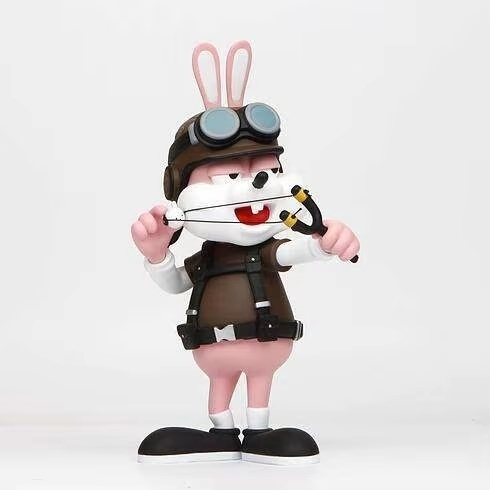
This Eco-Friendly PVC Toy is a custom designer rabbit character figure made with recyclable PVC material. It adopts non-toxic, durable and environmentally friendly production process, with smooth surface, stable structure and carefully hand painted finish.
The figure features a playful rabbit pilot character with pink ears, brown helmet, goggles, black vest and cartoon action pose. The eco-friendly PVC material ensures safe contact, long-term collection and repeated display.
We support Eco-Friendly PVC Toy customization, including character design, material adjustment, color matching, hand painting and packaging. Suitable for designer toy projects, brand gifts, promotional merchandise and limited edition releases.
- Eco-Friendly PVC Toy, custom designer rabbit character figure
- Made with recyclable, non-toxic and durable PVC material
- Playful rabbit pilot design with goggles and brown vest
- Smooth surface, stable structure and hand painted details
- Custom design, eco-friendly material & packaging available
Note:
The toy figure images shown on our website are intended solely as references for customization and are not available for purchase. As a professional ODM/OEM toy manufacturer, we focus on customizing and producing toy figures of comparable style. If you have an original figure design you’d like to produce, please reach out to us for a quotation.
What "Eco-Friendly PVC Toy" Can Actually Mean?
Product Display
Material Comparison: Which Polymer Actually Carries the Claim
| Material | Recyclability | Plasticizer concern | Carbon / feedstock options | Where it loses |
|---|---|---|---|---|
| PVC (rigid or flexible) ⭐ first choice | Single-material PVC is mechanically recyclable and has an established EU recycling route | Fully avoidable with a phthalate-free system | Bio-attributed grade available under ISCC PLUS mass balance | Public perception, not technical performance; chlorine chemistry is energy intensive at the front end |
| PP / PE (polyolefin) | Excellent, widely collected | None — no plasticizer needed | Bio and recycled grades widely available | Softer detail, limited gloss, harder to hold fine paint edges on a collectible |
| ABS | Moderate; multi-material blends complicate it | None | Recycled and mass-balance grades exist | Rigid only; needs solvent bonding for assembly, which undermines disassembly |
| Resin (cast polyurethane / epoxy) | Poor — thermoset, not remeltable | Not applicable | Bio-based polyol options exist | Cannot be recycled mechanically; fine for small editions, wrong for volume green claims |
| Bio-based / compostable PLA blends | Industrial compost only, not home compost | None | Bio-based by definition | Low heat resistance; a figure left in a warm car deforms; no realistic toy-market collection route |
| Silicone | Very limited | None | — | Cost and paint adhesion; rarely the whole build |
Craft Comparison: Where Each Process Helps or Hurts the Claim
| Process | Effect on the environmental claim | Effect on the product |
|---|---|---|
| Injection molding, single material ⭐ | Best case: one polymer, snap-fit or screw assembly, fully disassemblable | Highest tooling; pays off at volume; sharpest detail |
| Injection molding, overmolded multi-material | Weakens the claim — permanently bonded dissimilar polymers cannot be separated at end of life | Better grip, softer touch zones, more design freedom |
| Rotocast vinyl | Good for single-material hollow builds; low tooling makes small runs viable | Slightly softer surface detail; ideal for larger hollow figures |
| Solvent / adhesive bonding | Hurts the claim — glued joints are the main barrier to disassembly | Simplest assembly for complex shapes |
| Snap-fit and screw assembly | Supports the claim — parts come apart and go back together | Needs tolerance discipline; adds a small assembly cost |
| Pad printing, water-based inks | Neutral to positive; lower solvent load in the print process | Standard retail look; needs curing discipline |
| Hand painting | Neutral on material, positive on durability — a well-painted figure is kept, not discarded | The collectible quality buyers pay for |
| Flocked or metallized finishes | Hurts the claim — adds a second material layer that cannot be separated | Strong shelf appeal for specific categories |
Safety Standards & Certifications
| Standard / document | Scope | What it substantiates |
|---|---|---|
| CE marking | EU market access | Declaration of conformity for the finished toy |
| EN71-3 | EU migration limits | Heavy-metal migration from polymer, paint and print — the technical basis for a "non-toxic" statement |
| EN71-1 / -2 | EU mechanical + flammability | Physical safety and burning behavior of the finished article |
| ASTM F963 | US toy safety | Mechanical, chemical and labeling requirements |
| CPSIA | US federal | Lead and phthalate limits; the basis for a "phthalate-free" claim in the US |
| Formulation declaration | Supply chain | A signed statement of the plasticizer system and polymer grade used in your order — what an auditor asks for first |
| ISCC PLUS certificate chain | Bio-attributed material | Mass balance accounting from feedstock to resin; verifiable in the public ISCC database |
| Recycled content certification | On request | Third-party verification of post-consumer or post-industrial content per component |
| REACH SVHC screen | EU chemical | Substance-of-concern screening beyond the toy-specific list |
| Prop 65 | California | Warning assessment for US West Coast distribution |
| ISO 14021 | Claim methodology | The international baseline for self-declared environmental claims — used by both EU and UK regulators as a substantiation reference |
| ISO 14067 / PCF study | On request | Product carbon footprint, if you intend to publish a carbon figure rather than a generic claim |
Care & Maintenance
- Dust with a dry microfiber cloth — and note that keeping a figure in good condition is the most defensible environmental argument a toy can make.
- Clean with a barely damp cloth; avoid alcohol and solvent wipes, which attack the plasticizer system and dull gloss finishes.
- Keep out of direct sunlight. UV yellowing is irreversible and shortens the figure's usable life more than handling does.
- Do not store in a hot car or on a windowsill; flexible PVC softens and can take a permanent lean above roughly 60 °C (140 °F).
- Store at moderate humidity. Long damp storage is what encourages surface bloom on flexible PVC, not normal display.
- Avoid contact with other plastics and printed materials for long periods — plasticizer migration between touching surfaces can soften or mark them.
- Keep the original box, and keep the documentation with it. If a claim is ever queried, the formulation declaration and test report that came with that batch are your evidence.
- Do not paint, glue or modify the figure; a modification voids both the safety report and the claim it supports.
- Where the figure is designed for disassembly, keep the fasteners. Reassembly depends on parts that are easy to lose.
- At end of life, separate the parts as designed before recycling — a figure recycled whole with its inserts intact loses the benefit the design was meant to deliver.